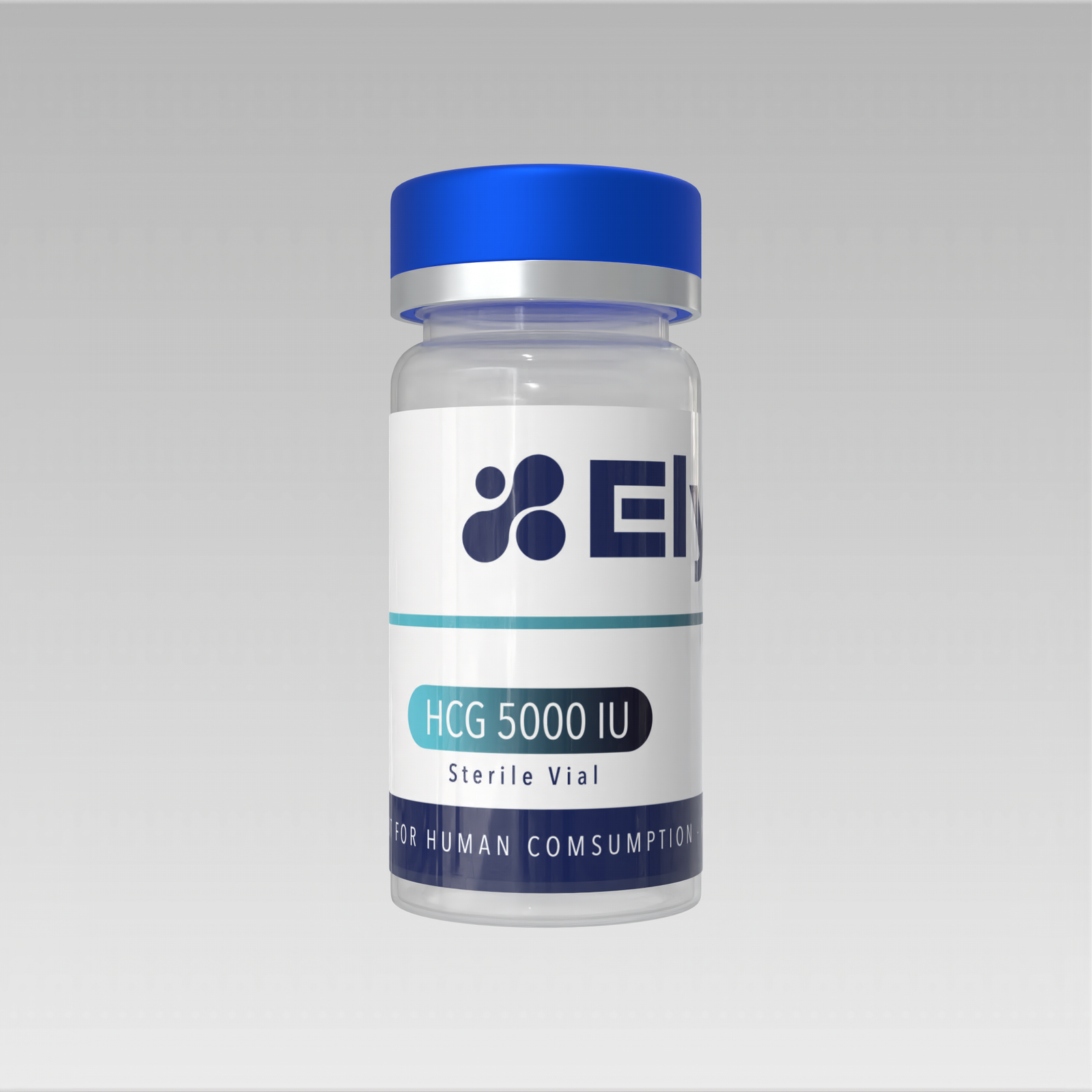
🔹 In-depth Scientific Profile
Human Chorionic Gonadotropin (hCG) is a glycoprotein hormone (MW: 36,700 Da) composed of two subunits (α: 92 aa, β: 145 aa) joined non-covalently. Naturally produced by the placental syncytiotrophoblast during pregnancy, hCG exhibits biological activity analogous to pituitary LH (luteinizing hormone) with greater potency and an extended half-life.
Molecular Structure:
- Alpha subunit Identical to LH, FSH, TSH (common)
- Beta subunit: Specific hCG (confers biological specificity)
- Glycosylation: 30% molecular weight (4 N-glycosylation sites, 4 O-glycosylation sites)
- Half-life: 24–36 hours (vs. 20 min LH, due to hyperglycosylation)
Mechanisms of Action:
- LH/hCG Receptor Activation (LHCGR):
- Receptor: GPCR (7-transmembrane) in testicular Leydig cells, ovarian theca
- Translation: Gs protein coupling → adenylate cyclase → ↑ cAMP → PKA
- Cascade: StAR (steroidogenic acute regulatory protein) phosphorylation
- Result: Mitochondrial cholesterol transport → steroidogenesis
- Testicular Steroidogenesis:
- Leydig cells: testosterone synthesis stimulation
- Key enzymes: CYP11A1 (side-chain cleavage), 3β-HSD, 17β-HSD
- Testosterone production: 200–400% increase in baseline levels
- Paracrine effects: spermatogenesis support (Sertoli cells)
- Ovarian Function
- Preovulatory follicle: final maturation, ovulation
- Corpus luteum: maintenance of progesterone production
- Luteinization: granulosa/theca cell differentiation
- Angiogenesis: luteal body vascularization (VEGF pathway)
Recombinant hCG Pharmacokinetics:
- SC bioavailability: 40–50% (vs. 100% IM)
- IM bioavailability: ~100%
- Tmax: 12-24 hours (SC), 6-12 hours (IM)
- Half-life: 29-36 hours (allows for 2-3x/week dosing)
- Renal clearance: primary
- Detection: urine/serum up to 7-14 days post-administration
🔹 Applications, Mechanisms, and Extended Research
1. MALE FERTILITY AND SPERMATOGENESIS
Hypogonadotropic Hypogonadism:
Steroidogenesis Restoration
- Serum testosterone: increase from <100 ng/dL to 400-700 ng/dL
- Response time: detectable levels 48-72h, normalization 2-4 weeks
- Typical research dose: 500-2500 IU 2-3x/week
- Maintenance: reduced dose after normalization
Spermatogenesis Induction
- Combination: hCG + hMG (FSH-like) or hCG + recombinant FSH
- Sperm concentration: increase from azoospermia to 5-15 million/mL (12-24 months)
- Motility: improvement 30-40%
- Prolonged treatment: 18-24 months typical for complete spermatogenesis
Cryptorchidism (Animal Models):
- Testicular descent: gubernaculum stimulation
- Success rate: 20-40% spontaneous reduction (pre-surgical)
- Protocol: 250-1000 IU 2x/week, 4-6 weeks
- Mechanism: androgens + insulin-like factor 3 (INSL3)
2. PREVENTION OF TESTICULAR ATROPHY DURING GONADAL SUPPRESSION
Androgen Suppression Models
Use of Exogenous Androgens (Research):
- Negative feedback: exogenous testosterone → LH/FSH suppression → testicular atrophy
- Preventive hCG: maintains intratesticular Leydig cell stimulation
- Testicular volume: preservation 70–851 TP3T vs. 40–601 TP3T without hCG
- Intratesticular testosterone: maintenance of high local levels (spermatogenesis)
Preventive Protocols
- Dosage: 250-500 IU 2x/week during suppression
- Timing: simultaneous onset with exogenous androgens
- Recovery: Reduced post-cycle recovery time 50%
3. BODY WEIGHT AND COMPOSITION (CONTROVERSIAL)
Simeons Protocol (Historical):
Original Concept (1954):
- hCG 125-200 IU/day + 500 cal/day diet
- Hypothesis: hCG mobilizes “abnormal” fat without hunger
- Weight loss: 0.5-1 lb/day reported
Modern Scientific Evidence:
- Meta-analysis (Lijesen et al., 1995): No significant difference vs placebo
- Weight loss: attributable to severe caloric restriction, not hCG
- Hunger: validated reduction vs. placebo
- Lean mass: significant loss (negative effect)
Conclusion Consensus:
- hCG for weight loss No robust scientific evidence
- FDA (1975): “Not effective for obesity” labeling”
- Research use: focus on reproductive/endocrine mechanisms
4. DIAGNOSIS AND TESTING LEYDIG CELL FUNCTION
hCG Stimulation Test:
Diagnostic Protocol:
- Basal: testosterone, LH, FSH
- Administration: 1500-5000 IU hCG single IM dose
- Post-stimulation: testosterone 72-96h after
- Interpretation
- Normal response: ↑ testosterone >200 ng/dL above baseline
- Primary failure: no response (Leydig cell damage)
- Secondary failure: present response but low baseline
Applications:
- Differentiation between primary and secondary hypogonadism
- Pre-pubertal Leydig cell reserve evaluation
- Treatment response prediction
5. OVULATION INDUCTION (Female Models)
Assisted Reproductive Technologies
Ovulatory Trigger
- Timing: Administration when dominant follicle ≥18-20mm
- Dosage: 5,000-10,000 IU single dose
- Ovulation: 34-36 hours post-administration
- Mechanism: mimics natural LH surge
Luteal Phase Support
- Dosage: 1500-2500 IU every 3-4 days
- Duration: 2 weeks post-ovulation
- Maintenance: corpus luteum progesterone production
- Alternative: exogenous progesterone (most common clinically)
Controlled Superovulation
- Combination: FSH + hCG final maturation
- Models: IVF, assisted reproduction research
- Multiple follicles: synchronized development
- Precise timing: oocyte retrieval 34-36h post-hCG
🔹 ADVANCED RESEARCH PROTOCOLS
Dosage Male Models
Rodents (Rats/Mice):
| Application |
Dosage |
Frequency |
Way |
Duration |
Notes |
| Steroidogenesis |
10-50 user interface |
2-3 times/week |
SC/IP |
2-8 weeks |
Hypogonadism model |
| Spermatogenesis |
20 UI |
2 times per week |
SC |
8-16 weeks |
Combine FSH-like |
| Acute Leydig Test |
50-100 UI |
Single dose |
IP |
24-72 hours |
Testosterone Measurement |
| Cryptorchidism |
5-10 UI |
2 times per week |
SC |
4 weeks |
Pre-pubertal model |
Non-Human Primates
| Objective |
Dosage |
Frequency |
Way |
Duration |
| Fertility |
100-500 IU |
2 times per week |
I am |
12-24 weeks |
| Testicular maintenance |
250 UI |
2 times per week |
SC/IM |
As needed |
Female Model Dosages
Rodents:
| Application |
Dosage |
Timing |
Way |
Notes |
| Ovulation induction |
5-10 UI |
Proestrus |
IP |
48 hours after PMSG |
| Superovulation |
5-10 UI |
48 hours after PMSG |
IP |
IVF Protocol |
| Luteal maintenance |
2-5 UI |
Every 2-3 days |
SC |
Post-ovulation |
Rabbits/Primates:
| Objective |
Dosage |
Protocol |
| Ovulation trigger |
100-250 IU |
Single dose, mature follicles |
| Luteal support |
50-100 UI |
Every 3-4 days x2 weeks |
In Vitro Studies
Primary Leydig Cells
- Concentration: 0.1-10 IU/mL (typically 1 IU/mL)
- Steroidogenesis: testosterone measurement ELISA 24-48h
- Gene expression: StAR, CYP11A1, 3β-HSD (RT-qPCR)
- Viability: MTT, apoptosis (Annexin V)
- Signaling: Intracellular cAMP (ELISA/Radioimmunoassay)
Granulosa cells
- Concentration: 1-10 IU/mL
- Luteinization: progesterone production
- Receptor expression: LHCGR, FSHR
- Proliferation: BrdU incorporation
Testicular Explants:
- Organotypic culture: immature testicular tissue
- hCG: 0.5-5 IU/mL medium culture
- Maturation: seminiferous tubule development
- Spermatogenesis: Histological Analysis
🔹 Reconstitution and Administration Methods
hCG Preparation (Typically Lyophilized):
- Sales Presentation
- Lyophilized vial + diluent (bacteriostatic water or saline)
- Common concentrations: 5,000 IU, 10,000 IU per vial
- Reconstitution Protocol:
- Clean the stoppers on both vials with 70% alcohol
- Add diluent to the lyophilized hCG vial:
- 5,000 units 5mL → 1,000 IU/mL
- 10,000 IU 10mL → 1,000 IU/mL
- Slowly inject through the vial wall
- Gently swirl (DO NOT shake vigorously)
- Dissolving: 1-2 minutes, clear solution
- Verification:
- Clear, colorless solution
- Without particles or precipitate
- Discard if cloudy
Storage:
| State |
Conditions |
Duration |
Notes |
| Freeze-dried without reconstitution |
2-8°C (refrigerator) |
24-36 months |
Protect light, original seal |
| Reconstituted (bacteriostatic water) |
2-8°C, dark |
30-60 days |
According to manufacturer/condom |
| Reconstituted (saline) |
36-46°F |
7-10 days |
Without a condom, quick use |
| Frozen aliquots |
-4°F |
90 days |
Some protocols, verify stability |
Administration Routes
- Intramuscular (IM) First choice, optimal bioavailability
- Subcutaneous (SC) Acceptable, bioavailability ~40–50% IM
Intraperitoneal (IP): Small rodents, preclinical research
🔹 RESEARCH FAQ
hCG vs. TRT (Testosterone Replacement Therapy) for Hypogonadism R: Critical differences:
hCG
- Intratesticular testosterone: maintained (spermatogenesis preserved)
- Testicular volume: preserved
- Fertility: maintained/restorable
- Frequency: 2-3x/week
- Cost: higher
TRT
- Intratesticular testosterone: suppressed (atrophy, infertility)
- Testicular volume: reduced 30-50%
- Fertility: compromised
- Frequency: variable (daily-weekly depending on formulation)
- Cost: lower
Choice: hCG if fertility/testicular function is important; TRT if only androgen replacement.
Q: hCG + FSH combination protocol for spermatogenesis? Standard protocol for hypogonadotropic hypogonadism:
- hCG 1500-2500 IU, 2-3x/week (Leydig/testosterone stimulation)
- Recombinant FSH 75-150 IU, 3x/week (direct spermatogenesis)
- Duration: 12-24 months typically
- Monitoring Seminal analysis every 3 months, testosterone monthly
- Success rate: Detectable sperm in 60–80% cases
LH/hCG receptor desensitization? Possible with high doses or excessive frequency:
- Downregulation Chronic high exposure → reduction LHCGR expression
- Prevention Physiological doses (500-1500 IU 2-3x/week)
- Signs Decreased testosterone response, requires increasing doses
- Recovery Rest 4-8 weeks to restore sensitivity
Main side effects research? Dose-dependent effects:
- Leaves: Injection site pain, fluid retention, acne
- Moderates Gynecomastia (testosterone aromatization→estradiol)
Rare: Hyper
Research material only. This product is intended for scientific research in controlled laboratory settings only. It is not a drug. Not for human or animal use, not for diagnostic or therapeutic use.