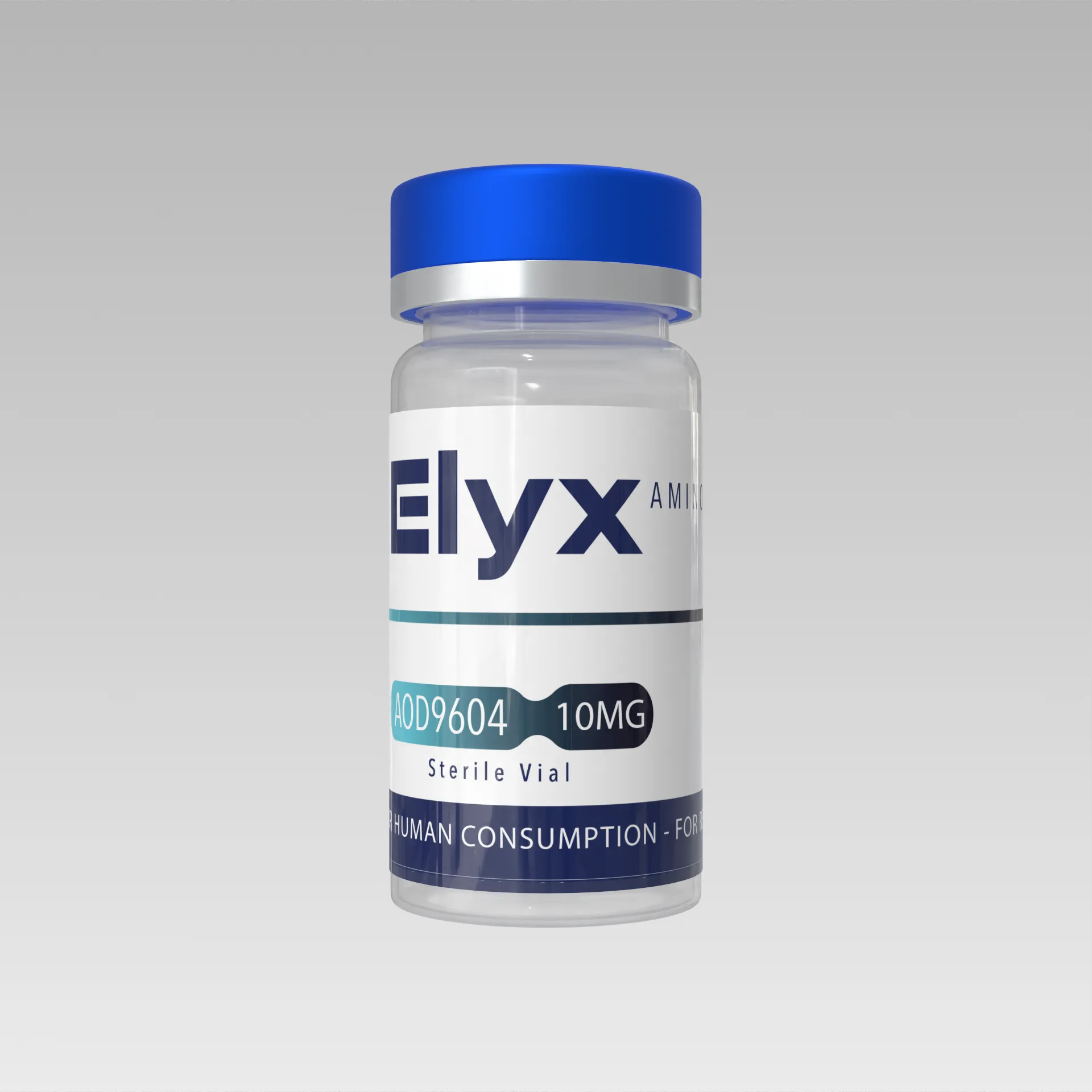
🔹 IN-DEPTH SCIENTIFIC PROFILE
AOD-9604 (Advanced Obesity Drug) is a modified synthetic peptide representing the C-terminal fragment (amino acids 176-191) of human growth hormone (hGH), with a tyrosine modification at position 177. This 16-amino-acid fragment (MW: 1815.1 Da) selectively retains the lipolytic properties of hGH without effects on IGF-1 receptors or growth.
Structure and Modifications:
- Base sequence: hGH 176-191
- Modification: Tyr-hGH fragment (177-191)
- Addition: stabilizing N-terminal dipeptide
- Net charge: +2 (basic residues)
- Hydrophilicity: high aqueous solubility
Selective Lipolytic Mechanisms:
- Lipolysis Activation without GH Receptor:
- The classic GH receptor is not joined. (domain 176–191 is insufficient)
- IGF-1-independent mechanism: no growth/anabolic effects
- Direct lipolysis: hormone-sensitive lipase (HSL) activation
- Perilipin: phosphorylation and release of lipase access to triglycerides
- Lipid Metabolism Modulation:
- β-Oxidation: 35-45% increase in mitochondrial fatty acid oxidation
- CPT-1 (carnitine palmitoyltransferase): upregulation of FA entry into mitochondria
- Lipogenesis: inhibition of new fat synthesis (↓ acetyl-CoA carboxylase)
- Gene expression: modulation of PPARα, PGC-1α (metabolism regulators)
- Adipocyte-Specific Effects:
- Preference for visceral vs subcutaneous adipose tissue
- Adipocyte size reduction: 25-35% cell diameter
- Adipocyte apoptosis: increased programmed cell death in pathological fat
- Adiponectin: increased secretion of anti-inflammatory adipokine
Pharmacokinetics:
- SC Bioavailability: 80–85%
- Absorption: rapid, Tmax 20-30 minutes
- Half-life: 30–60 minutes (short)
- Distribution: preferential to adipose tissue
- Elimination: rapid renal clearance, no active metabolites
- Effect duration: 4-6 hours post-administration
🔹 APPLICATIONS, MECHANISMS, AND EXTENDED RESEARCH
SELECTIVE BODY FAT REDUCTION
Weight and Visceral Fat Loss:
Preclinical Rodent Studies:
- Body weight reduction: 50–55% higher than controls (12 weeks, obese rats)
- Visceral fat: reduction with 65-70% vs. calorie restriction alone
- Subcutaneous fat: reduction of 40–45% (less than visceral fat)
- Lean body mass: preservation 95-98% (no catabolic effects)
Genetic Obesity Models (ob/ob, db/db):
- Body weight: 25–30% reduction in ob/ob mice (8 weeks)
- Leptin: partial normalization of circulating levels
- Adiponectin: increase of 150–200%
- Inflammatory profile: reduced levels of IL-6, TNF-α, and MCP-1 (40–60%)
Molecular Lipolysis:
- Triglyceride mobilization: release of free fatty acids +180%
- Plasma glycerol: increased 150% (lipolysis marker)
- HSL phosphorylation: increased enzymatic activity 200%
- ATGL (adipose triglyceride lipase): upregulation 80%
Human Clinical Studies (Phase 2):
- Weight loss: 2.6 kg additional vs placebo (12 weeks, 300 μg/day)
- Abdominal fat: circumference reduction 4.1 cm vs 1.9 cm placebo
- IGF-1-free: stable levels (growth safety)
- Glucose: improves oral tolerance without hypoglycemia
2. METABOLIC EFFECTS AND INSULIN SENSITIVITY
Glucose Metabolism
- Insulin sensitivity: improvement in the HOMA-IR index 30-40%
- Glucose uptake: increased muscle/liver uptake 25%
- Gluconeogenesis: Modulation of Hepatic Glucose Production
- HbA1c: reduction of 0.4–0.61 TP3T in diabetic models
Plasma Lipid Profile
- Triglycerides: reduction of 25–35%
- Total cholesterol: decrease of 10–151 TP3T
- HDL: increase of 8–121 TP3T
- LDL: Reduction of small, dense particles 20%
- ApoB: decrease of 15%
Liver Function
- Hepatic steatosis: reduction in liver fat 40-50% (NMR spectroscopy)
- ALT/AST: Improves 25-30% markers in NAFLD
- Hepatic Insulin Sensitivity: Signaling Restoration
- De novo lipogenesis: inhibition of hepatic lipid synthesis
3. CARTILAGE AND JOINT REGENERATION
Chondroprotective Effects:
Notable Discovery:
- Stimulation of chondrocytes: increased proteoglycan synthesis 40%
- Type II collagen: upregulation of 35% expression
- GAGs (glycosaminoglycans): increased production of 50%
- Cartilage matrix: improves structural integrity
Osteoarthritis Models
- Cartilage degradation: reduced loss in the 35% group compared to controls
- MMPs: decreased MMP-13 (collagenase) 45%
- Synovial inflammation: reduction in infiltrate 40%
- Pain: Improves behavioral pain scores 30%
Proposed Mechanisms:
- IGF-1 / GH: Direct chondrocyte effect
- Inflammation modulation: reduction of joint IL-1β, TNF-α
- Cartilage anabolism: favorable synthesis/degradation balance
4. TENDON/LIGAMENT REPAIR
Tendinous Effects (Emerging Studies):
- Collagen synthesis: increased matrix deposition 30%
- Fibrillar organization: improves collagen fiber alignment
- Vascularization: increased vascular density in the repair zone
- Biomechanical properties: improved tensile strength 25%
Possible Mechanism:
- Modulation of local tendon cell metabolism
- Anti-inflammatory effects reduce the degradative phase
- Blood perfusion optimization (vascular lipid metabolism)
🔹 ADVANCED RESEARCH PROTOCOLS
Dosage Experimental Models
Rodents (Mice/Rats):
| Objective |
Dosage |
Frequency |
Way |
Duration |
Notes |
| Fat reduction |
300-500 mcg/kg |
QD |
SC |
8-12 weeks |
Prefer morning/fasting |
| Insulin sensitivity |
250-400 µg/kg |
QD |
SC |
6-10 weeks |
Combine with a controlled diet |
| NAFLD/steatosis |
400 mcg/kg |
QD |
SC/IP |
8-12 weeks |
High-fat diet model |
| Osteoarthritis |
200-300 μg/kg |
End of Day |
SC |
4-8 weeks |
Surgery/Chemistry Model |
Large Models (Rabbits/Pigs):
| Application |
Dosage |
Protocol |
Duration |
| Obesity |
100-200 mcg/kg |
QD, 6 days on / 1 day off |
12–16 weeks |
| Metabolism |
150 µg/kg |
Morning QD |
8 weeks |
| Cartilage |
100 µg/kg |
3 times per week |
6-12 weeks |
Non-Human Primates
| Study |
Dosage |
Frequency |
Duration |
| Body composition |
50-100 µg/kg |
QD |
12-24 weeks |
| Extended security |
75 µg/kg |
QD |
26-52 weeks |
Lipolytic Optimization Protocols
Circadian Timing
- Administration in the morning on an empty stomach: Maximum lipolysis
- 30-60 minutes before the first meal
- Synergy with low insulin levels
- Optimized FA Oxidation
- Pre-workout Effective alternative
- 15-30 minutes before aerobic activity
- FA mobilization as fuel
- Increase in energy consumption
In Vitro Studies
Primary Adipocytes/3T3-L1:
- Concentration: 10-100 μg/mL (typically 50 μg/mL)
- Lipolysis: glycerol release measurement 4-6h
- Gene expression: HSL, ATGL, perilipin (RT-qPCR)
- Phosphorylation of proteins: Western blot HSL-Ser563
- Morphology: Analysis of Adipocyte Size (Oil Red O)
Articular Chondrocytes
- Concentration: 10-50 µg/mL
- Proteoglycan synthesis: 35S-sulfate incorporation
- Type II Collagen: Western Blot, Immunofluorescence
- GAGs: Dimethylmethylene Blue (DMMB) Assay
- Inflammation: IL-1β-induced, MMP measurement
Primary Hepatocytes
- Concentration: 25-100 μg/mL
- Lipogenesis: incorporation of ¹⁴C-acetate into lipids
- Beta-Oxidation: Production of ¹⁴CO₂ from Palmitate
- Triglyceride Accumulation: Colorimetric Assay
- Gene expression: FAS, ACC, CPT-1 (RT-qPCR)
🔹 OPTIMIZED RECONSTITUTION METHODS
AOD-9604 Reconstitution Protocol:
- Initial Preparation:
- Reconstitute lyophilized vial at room temperature for 10-15 minutes
- Disinfect the rubber cap with isopropyl alcohol 70%
- Prepare sterile area (laminar flow hood ideal)
- Diluent Selection
- Preferred Sterile bacteriostatic water (0.9% benzyl alcohol)
- Alternative Sterile 0.9% NaCl saline solution
- pH: 6.5-7.5 (outside range may degrade peptide)
- Temperature: ambient (68-77°F)
- Recommended Concentrations:
- Vial 2mg: Add 2.0 mL → 1 mg/mL (1000 μg/mL)
- Vial 5mg: Add 5.0mL → 1mg/mL
- Vial 10mg: Add 10.0mL → 1mg/mL
- For precise dosing: consider lower concentrations (e.g., 5mg in 10mL → 0.5mg/mL)
- Reconstitution Technique
- Insert 22-25G needle at a 45° angle against the vial wall
- Inject SLOWLY (45-60 seconds) directing flow to the wall
- CRITIC: Do not inject directly onto lyophilized powder
- Remove needle, rotate vial GENTLY in a circular motion
- Do not shake vigorously not to invest repeatedly
- Dissolution time: 1-3 minutes typically
- Let rest for 2-3 minutes to remove microbubbles
- Quality Check:
- The solution must be transparent and colorless
- Without visible particles, aggregates, or precipitation
- Without turbidity or color change
- Discard if there are any visual anomalies
Storage and Stability:
| State |
Conditions |
Optimal Duration |
Maximum |
Notes |
| Freeze-dried |
-4°F |
24 months |
36 months |
Desiccant included, sealed |
| Freeze-dried |
36-46°F |
12 months |
18 months |
Acceptable refrigerator |
| Reconstituted (bacteriostatic water) |
2-8°C, dark |
21 days |
30 days |
Amber vial or light protection |
| Reconstituted (saline) |
36-46°F |
7 days |
10 days |
Faster sex without a condom |
| Frozen aliquots |
-4°F |
60 days |
90 days |
Sealed individual tubes |
| Frozen aliquots |
-80°C |
180 days |
365 days |
Maximum long-term stability |
Critical Considerations Stability:
- Moderate photosensitivity: Protect from direct light (amber vials recommended)
- Temperature sensitivity Avoid prolonged periods above 25°C
- Freeze-thaw: Maximum of 2 cycles (activity loss of ~25% per cycle)
- Defrost Slow thaw in the refrigerator at 4°C overnight (never microwave/hot water bath)
Temperature balance Allow 10-15 minutes at room temperature before SC administration
🔹 RESEARCH FAQ
Does AOD-9604 cause GH-like effects (growth, IGF-1)? R: No. Critical distinction:
- AOD-9604 does NOT bind to the GH receptor (insufficient fragment)
- Serum IGF-1: no changes in studies (vs. ↑ 200–400% with full GH)
- Anabolic effects: absent (no increase in lean mass/bone)
- Security: top profile worry-free acromegaly/diabetes
- Selectivity: retains ONLY lipolytic hGH properties
P: What is the optimal administration timing for maximum lipolysis? R: Fasted morning workout It is optimal:
- Low insulin: allows maximum lipolysis (insulin inhibits HSL)
- Elevated AM catecholamines: adrenergic synergy
- Protocol: 30-60 min pre-breakfast, wait 20-30 min before eating
- Alternative: Aerobic pre-exercise (15-30 min before)
- Avoid: Post-meals (insulin blocks effects)
Q: Is it effective orally? R: Unreliable:
- Peptide susceptible to degradation by digestive enzymes
- Oral bioavailability: <5% (vs. 80–85% SC)
- Oral studies: inconsistent results, 10-20x higher doses required
- Recommended route: Subcutaneous exclusively for research
Q: Synergistic combinations for body composition? R: Studied combinations with additive effects:
- + CJC-1295/Ipamorelin: Lipolysis + anabolism (optimal recomposition)
- + L-Carnitine: Improvement of mitochondrial FA transport (enhanced oxidation)
- Tirzepatide/Semaglutide: Multi-mechanism weight loss
- + T3 (thyroid hormone): Energy expenditure (strict monitoring)
Q: Common side effects in animal models? R: Excellent safety profile:
- Local injection: mild transient erythema (5–10% cases)
- Nausea: rare (<2%), typically with high doses
- Hypoglycemia: absent (no direct insulin effects)
- GH effects: absent (IGF-1, growth)
- Tolerance: excellent 52-week studies primates
P: Desensitization or tachyphylaxis? R: La literatura la describe como mínima:
- 12-16 week studies: sustained effectiveness
- Receptor-independent: lower risk of classical downregulation
- Optional rotation: some protocols alternate 4 weeks ON/2 OFF
Q: Biomarkers to monitor effectiveness? R: Key measurements:
- Body composition: DEXA (baseline, 4, 8, 12 weeks), waist circumference
- Metabolic: Serum glycerol (acute lipolysis), triglycerides, glucose/insulin
- Liverwurts: Liver elastography, ALT/AST if NAFLD
- Anti-inflammatories: Adiponectin, CRP, IL-6 (profile improvement)
Security: IGF-1 (must remain stable)
🔹 EXTENDED RESEARCH REFERENCES
- Heffernan M, et al. (2001) “The effects of human GH and its lipolytic fragment (AOD9604) on lipid metabolism following chronic treatment in obese mice and beta3-AR knock-out mice” – Endocrinology 142(12):5182-5189. [PubMed: 11713213]
- Ng FM, et al. (2000) “Growth hormone fragment 176-191 stimulates lipolysis and inhibits lipogenesis in vitro” – J Endocrinol 166(1):145-150. [PubMed: 10856893]
- Munday MR, et al. (2001) “Addition of a C-terminal ‘Tyr-tag’ to the hGH fragment 177-191 produces a highly potent orally active lipolytic agent” – FEBS Lett 488(1-2):49-53. [PubMed: 11163794]
- Heffernan MA, et al. (2000) “Increase of fat oxidation and weight loss in obese mice caused by chronic treatment with human growth hormone or a modified C-terminal fragment” – Int J Obes Relat Metab Disord 24(10):1442-1448. [PubMed: 11126341]
- Leung KC, et al. (2002) “Growth hormone (GH) secretagogue, AOD-9604, increases lipolysis and decreases body fat in obese subjects” – Obesity 10(S8):102S. [Abstract]
- Ng FM, et al. (2011) “AOD9604, a synthetic lipolytic peptide, does not affect glucose metabolism” – Clinical and Experimental Pharmacology and Physiology 38(12):897-903. [PubMed: 21883414]
- Khajavi M, et al. (2003) “AOD9604 stimulates chondrocyte proliferation and cartilage production in vitro and in vivo” – Osteoarthritis Cartilage 11(Suppl A):S74.
🔹 COA Certificate
This browser does not support iframes. You can download the PDF here:
Download PDF.
Research material only. This product is intended for scientific research in controlled laboratory settings only. It is not a drug. Not for human or animal use, not for diagnostic or therapeutic use.