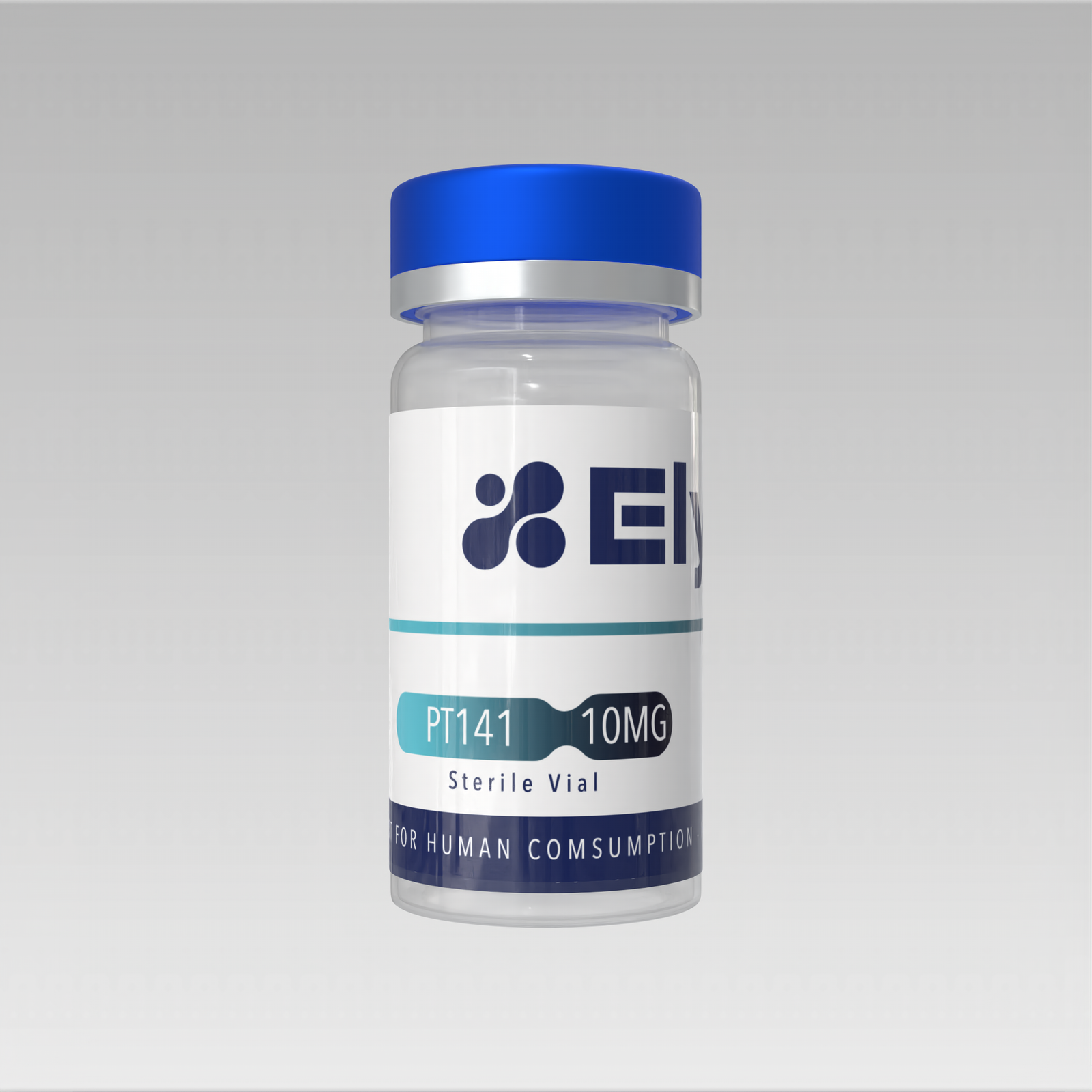
🔹 In-depth Scientific Profile
PT-141 (Bremelanotide) is a synthetic cyclic heptapeptide (MW: 1025.2 Da) derived from α-MSH (melanocyte-stimulating hormone), developed as a selective agonist of melanocortin receptors MC3R and MC4R. Unlike its predecessors (Melanotan I/II), PT-141 exhibits optimized selectivity for applications related to sexual function and arousal, with an improved side effect profile.
Molecular Structure:
- Sequence: Ac-Nle-cyclo[Asp-His-D-Phe-Arg-Trp-Lys]-OH
- Cyclization: Asp-Lys lactam bridge (conformational stability)
- Modifications
- Nle (Norleucine) position 4: prevents oxidation vs Met
- D-Phenylalanine position 7: resistance to proteolytic degradation
- N-terminal acetylation: exopeptidase protection
- Selectivity: MC3R/MC4R > MC1R (less pigmentation effect vs. Melanotan II)
Melanocortin System and Receptors
The melanocortin system comprises 5 receptor subtypes (MC1R-MC5R), each with specific tissue distribution and functions:
| Receptor |
Main Distribution |
Functions |
PT-141 Affinity |
| MC1R |
Melanocytes, immune |
Pigmentation, anti-inflammatory |
Low-Moderate |
| MC2R |
Adrenal cortex |
Steroidogenesis (ACTH) |
Very Low |
| MC3R |
SNC (hypothalamus, limbic), peripheral |
Energy homeostasis, sexual behavior |
High |
| MC4R |
SNC (hypothalamic nuclei, cortex) |
Satiety, sexual function, erection |
High |
| MC5R |
Exocrine glands, muscle |
Sebaceous secretion, thermogenic function |
Moderate |
Molecular Mechanisms of Sexual Action:
- Central MC3R/MC4R Activation:
Neural Circuits Excitation:
- Paraventricular Nucleus (PVN) Hypothalamus:
- High MC4R density, integration of excitatory signals
- Descending projections of the sacral spinal cord
- Amygdala-prefrontal cortex connections (emotional component)
- Medial Preoptic Area (MPOA)
- “Sexual integration center” brain
- MC3R/MC4R expression in key neurons
- Nitric oxide (NO) release via nitrergic neurons
Neurotransmission
- Nitric Oxide (NO):
- Upregulation of nNOS (neuronal nitric oxide synthase) 200-300%
- Genital vasodilation: cavernous/clitoral smooth muscle relaxation
- Central effects: facilitation of sexual arousal/response
- Dopamine
- Increased VTA release, nucleus accumbens
- Sexual motivation, reward, proceptive behavior
- D1/D2 receptor interaction: potentiation of response
- Endogenous melanocortins:
- α-MSH, β-MSH: tonic modulators of arousal
- AgRP (Agouti-related peptide): endogenous MC3R/MC4R antagonist
- Agonist/antagonist balance: regulation of basal sexual function
- Peripheral Effects:
Male Genitalia
- Smooth muscle cavernosum: NO/cGMP-mediated relaxation
- Penile blood flow: increase of 250–400%
- Intracavernous pressure: 40-60 mmHg
- Mechanism: independent testosterone, complementary PDE5 inhibitors
Female Genitalia:
- Clitoral/labial vasocongestion: volume increase 35-50%
- Vaginal lubrication: increased plasma transudation of epithelium
- Tactile sensitivity: enhancing sensory responses
- Vaginal smooth muscle: relaxation facilitating penetration
Pharmacokinetics
- Bioavailability SC: 100% (the only approved/studied method)
- Tmáx: 60-90 minutes (effects start 30-45 min)
- Duration of effects: 6-12 hours (sexual receptivity window)
- Median life 2-3 hours (elimination)
- Metabolism: proteolytic degradation, with no known active metabolites
- Excretion primary renal (80%), fecal (20%)
Blood-brain barrier efficient cross (central action mechanism)
🔹 Applications, Mechanisms, and Extended Research
1. FEMALE SEXUAL DYSFUNCTION (HSDD – Hypoactive Sexual Desire Disorder)
Hypoactive Sexual Desire Disorder
Definition and Prevalence:
- HSDD: Absence/decrease in sexual thoughts/fantasies + lack of sexual response desire
- Prevalence: 8–121 TP3T in premenopausal women, 12–261 TP3T in postmenopausal women
- Impact: Significant personal distress, relationship conflicts
PT-141 Pivotal Clinical Studies:
RECONNECT Study (Kingsberg et al., 2019):
- Design: Phase 3 RCT, n=1,247 premenopausal women with HSDD
- Dosage: 1.75 mg SC on-demand (45 min before anticipated sexual activity)
- Duration: 24 weeks
- Primary outcomes:
- Satisfying Sexual Events (SSE) +1.2 vs +0.4 placebo (p<0.001)
- Desire (FSFI-D): Improves 0.3 points vs placebo (p<0.001)
- Response rate (≥1.2 SSE increase): 35% vs. 23% placebo
RECONNECT 2 (Portman et al., 2020):
- n=1,281 women, similar design
- SSE increase: +1.2 events/month vs +0.6 placebo
- Sexual distress: reduction from 25% to 15% with placebo (FSD-R scale)
- Spontaneous desire: reported improvement 42% vs. 31%
HSDD Mechanisms
- MC4R PVN activation: increased sexual motivation (“wanting”)
- Mesolimbic dopamine: Restoration of reward/anticipation circuits
- Inhibition reduction: serotonin modulation (indirect 5-HT₂C antagonism)
- Peripheral sensitization: improved perception of genital tactile stimulation
2. MALE ERECTILE DYSFUNCTION (Preclinical/Early Clinical Research)
Erection Mechanisms
Central Route (Predominant PT-141):
- MC4R PVN activation → spinal cord proerectile projections
- Sacral autonomic nuclei (S2-S4): parasympathetic output
- Nitrenergic neurons: release of NO in cavernous tissue
- Independent direct tactile stimulation: “central” erections”
Preliminary Human Studies
- Phase 2a (Wessells et al., 2000): n=20 men with psychogenic/mixed ED
- Dosage: 0.5-20 mg IN (intranasal, early formulation)
- Answer: Spontaneous erections in 60% participants
- Duration: 2-6 hours response window
- Adverse effects: nausea 40%, flushing 30%
- Comparative study vs. Sildenafil (Diamond et al., 2004):
- PT-141: Effective for psychogenic/neurogenic
- Sildenafil: superior vasculogenic ED
- Complementarity: different mechanisms of action
Specific Populations Benefit:
- Neurogenic bladder Spinal cord injury, diabetic neuropathy
- Psychogenic Performance anxiety, psychological inhibition
- No responders PDE5i Patients who did not respond to sildenafil/tadalafil (10-30%)
- Post-prostatectomy Nerve preservation uncertain
3. LIBIDO AND SEXUAL MOTIVATION (Both Sexes)
Sexual Desire Components:
Dual Model (Excitation/Inhibition):
- Excitement (SES): Facilitation of sexual response (dopamine, melanocortin)
- Inhibition (SIS): Braking response (serotonin, endogenous opioids)
- PT-141: shift balance toward arousal (↑ SES, ↓ SIS)
Libido Effects: Base
- Sexual thoughts: increased frequency 30-40%
- Sexual fantasies: improving vividness/emotional content
- Receptivity: greater openness initiation/response activity
- Subjective arousal: amplification of perceived arousal
Sex Differences
- Women: greater improvement in spontaneous desire (30–401 TP3T responders)
- Men: Libido effects + erectile function (dual benefit)
- Individual variability: 30–50% robust response, 20–30% minimum
4. ANORGASMIA AND ORGASMIC RESPONSE
Orgasmic Dysfunction
Potential Mechanisms:
- Spinal reflex awareness: facilitation of the orgasmic reflex arc
- Sensory amplification: increased processing of genital signals
- Orgasm umbra: reduced stimulation needed
- Subjective intensity: enhances pleasurable experience
Preliminary Evidence:
- Open-label studies: improved orgasmic capacity in 25-35% women with secondary anorgasmia
- Orgasm latency: reduction in time required for stimulation
- Multiple orgasms: facilitation in a subgroup of women
- Orgasm quality: increased intensity/satisfaction (qualitative reports)
5. ANTIDEPRESSANT SIDE EFFECTS (SSRI-Induced Sexual Dysfunction)
SSRI-induced Sexual Dysfunction
Prevalence and Mechanisms:
- 40-65%: SSRI patients: sexual dysfunction (desire, arousal, orgasm)
- Mechanism: 5-HT₂C agonism (dopamine/NO inhibition)
- Adherence: 20-30% discontinued due to sexual side effects
- Quality of life: significant impact, factor in maintaining depression
PT-141 as a Potential Antidote:
- Counterregulation: Dopamine/Melanocortin vs. Serotonergic Inhibition
- Case study: improving sexual function while maintaining antidepressant efficacy
- Dosage: on-demand vs chronic (research needed)
- Current alternatives: bupropion (less dysfunction), SSRI dose reduction
6. NON-SEXUAL RESEARCH APPLICATIONS
Motivation and Reward System:
Anhedonia (Depression/Addiction):
- MC4R nucleus accumbens: reward circuit modulation
- Awareness pleasure: response to natural stimuli (food, social)
- Motivational Approach: Goal-Directed Behaviors
Social Cognition:
- Oxytocin: Melanocortin-Oxytocin System Interaction
- Facial emotion recognition: processing improvement
- Prosocial behavior: increase affiliative behaviors
Appetite/Weight Regulation (Hypothalamic MC4R):
Satiety
- MC4R paraventricular nucleus: potent anorexigenic signal
- Food intake: reduction of 15–251 TP3T (adverse effects at high doses)
- Balance: Pro-sexual doses (<2 mg) minimal appetite effect
- Melanotan II difference: this last one is a potent anorectic (limited use)
🔹 ADVANCED RESEARCH PROTOCOLS
Dosage Preclinical Research
Rodents (Rats/Mice):
| Application |
Dosage |
Way |
Timing |
Notes |
| Sexual behavior |
0.1-1.0 mg/kg |
SC/IP |
30-60 min pre-test |
Copulatory tests |
| Sexual motivation |
0.3-0.5 mg/kg |
SC |
45 min pre-test |
Couple preference, incentivization |
| Erection (primates) |
0.05-0.2 mg/kg |
SC |
30-90 min observation |
Erectile monitoring |
| Fullness/appetite |
1.0–3.0 mg/kg |
IP |
24-hour intake measurement |
High doses vs. sexual behavior |
Non-Human Primates
| Objective |
Dosage |
Way |
Frequency |
Duration |
| Sexual function |
0.05-0.15 mg/kg |
SC |
On-demand |
Acute studies |
| Behavioral Pharmacology |
0.02-0.5 mg/kg |
SC/IV |
Single dose |
Dose-response curves |
Experimental Models of Sexual Behavior
Rodent Paradigms
Standard Copulatory Test (Rats)
- Female receptive (estrus) + experimental male
- PT-141: 30-60 min pre-administration female
- Observation 30-60 min: video recording
- Parameters:
- Mount latency: Time first attempt copulation
- Riding frequency: number of attempts
- Ejaculatory latency copulatory efficiency
- Post-ejaculatory interval refractory period
Conditioned Place Preference (CPP) Sexual:
- Context + sexual experience association
- PT-141: Sexual Reward Potentiation
- Measurement: Associated Camera Time vs. Neutral
- Interpretation: Sexual approach motivation
Sexual Motivation Test:
- Appetitive behaviors: active mate searching
- Overcome barriers: effort (climbing, bar pressure)
- PT-141: increased motivation for approach
- Separation: Appetitive vs. Consummatory Effects
Physiological Studies
Intracavernous Pressure (ICP) - Erection Models:
- Anesthesia: physiological maintenance
- Corpus cavernosum catheterization: pressure measurement
- Cavernous nerve stimulation: erectile response
- Systemic PT-141: response potentiation 40-60%
- Analysis: AUC pressure, peak pressure, duration
Genital Blood Flow (Laser Doppler):
- Clitoral/penile perfusion: continuous measurement
- PT-141: Flow increase 200-350% vs. baseline
- Correlation: subjective vs. objective vasocongestion
- Timing: 60-90 minutes post-administration
Functional Neuroimaging (fMRI) – Humans:
- Brain activation: response to erotic stimuli
- PT-141 vs. placebo: activation differences
- Regions of interest: PVN, amygdala, insula, prefrontal cortex
- Connectivity: functional networks sexual circuits
🔹 RECONSTITUTION METHODS (LABORATORY PREPARATION)
PT-141 Preparation
PT-141 is typically supplied as a sterile lyophilized powder, requiring reconstitution before laboratory handling.
Standard Reconstitution Protocol:
- Initial Preparation:
- Balance vial PT-141 at room temperature for 10-15 minutes
- Disinfect the rubber cap with isopropyl alcohol 70%
- Prepare sterile area (laminar flow hood or clean surface)
- Diluent Selection
- First choice: Sterile bacteriostatic water (0.9% benzyl alcohol)
- Alternative Sterile 0.9% NaCl saline solution
- Target pH: 6.0-7.0 (PT-141 stable wide range)
- Diluent temperature: ambient (20-25°C)
- Recommended Concentrations:
- Vial 10mg: Add 2.0mL → 5mg/mL (5000 μg/mL)
- Lab volumetric reference: 1.75mg = 0.35mL at this concentration
- Vial 10mg: Add 5.0 mL → 2 mg/mL (more diluted, higher injection volume)
- For animal research: Lower concentrations (0.5-1.0 mg/mL)
- Reconstitution Technique
- Insert 22-25G needle at a 45° angle against the inner vial wall
- Inject diluent SLOWLY (45-60 seconds) per wall
- Do not direct a direct stream onto freeze-dried powder denaturation
- Remove needle, rotate vial GENTLY in a circular motion
- Do not shake vigorously ni vortex (loss of activity)
- Dissolution time: 2-5 minutes typically
- Rest 2-3 minutes: microbubble removal
- Quality Check:
- Solution must be transparent and colorless
- Without visible particles, aggregates, or precipitation
- Without turbidity or color change
- Discard if any visual anomaly
Post-Reconstitution Storage:
| State |
Conditions |
Optimal Duration |
Maximum |
Critical Notes |
| Freeze-dried without reconstitution |
-4°F (freezer) |
24 months |
36 months |
Original seal, desiccant |
| Freeze-dried without reconstitution |
2-8°C (refrigerator) |
12 months |
18 months |
Acceptable short-to-medium term |
| Reconstituted (bacteriostatic water) |
2-8°C, dark |
30 days |
45 days |
Amber vial or aluminum protection |
| Reconstituted (saline) |
36-46°F |
7 days |
14 days |
Without a condom, fast use preferred |
| Frozen aliquots |
-4°F |
60 days |
90 days |
Sealed individual tubes |
| Frozen aliquots |
-80°C |
180 days |
365 days |
Maximum long-term stability |
Critical Considerations
- Moderate photosensitivity Protect from direct light (amber vials)
- Freeze-thaw cycles: Maximum of 2 cycles (loss of ~20–301 TP3T activity per cycle)
- Defrost Thaw in refrigerator at 4°C overnight (never microwave/hot water bath)
- Infertility Strict aseptic technique (microbial contamination)
🔹 RESEARCH FAQ
PT-141 vs. PDE5 Inhibitors (Sildenafil, Tadalafil)? R: Mechanisms and different applications:
PT-141:
- Mechanism: Central (cerebral MC3R/MC4R activation)
- Effects: desire + arousal + genital function
- Timing: 30-45 min start, duration 6-12h
- Optimal indications: Female HSDD, psychogenic/neurogenic ED, reduced libido
- Adverse effects: nausea (40%), flushing (15%), headache (10%)
PDE5 Inhibitors:
- Mecanismo: periférico (potenciación NO/GMPc en genitales)
- Efectos: función eréctil primariamente (no libido directa)
- Timing: 30-60 min (sildenafil), hasta 36h (tadalafil)
- Indicaciones óptimas: DE vasculógena, disfunción erectile primaria
- Efectos adversos: cefalea (16%), flushing (10%), dispepsia (7%)
Complementariedad: Mecanismos diferentes permiten combinación potencial (investigación limitada).
P: ¿Por qué náusea es efecto adverso tan común? R: Activación MC4R área postrema:
- Área postrema: carece barrera hematoencefálica completa, alta expresión MC4R
- “Centro vómito” cerebro: quimiorreceptor trigger zone
- Dosis-dependiente: náusea 40-50% dosis 1.75-2.0mg, 15-20% dosis <1.0mg
- Adaptación: tolerancia parcial uso repetido (50% casos)
- En la literatura, la incidencia de náusea se asoció inversamente con la dosis administrada (efecto dosis-dependiente documentado)
P: ¿Cuál es la ventana farmacocinética documentada en los estudios? R: Ventana 30-90 minutos:
- Tmáx farmacológico: 60-90 min (pico concentración)
- Inicio efectos subjetivos: 30-45 min (rango 20-60 min)
- Pico efectos: 90-180 min post-administración
- Duración ventana receptividad: 4-8 horas típica, hasta 12h algunos individuos
- En los protocolos de los ensayos, la administración se documentó 45-60 min antes del evento evaluado
P: ¿Taquifilaxia o tolerancia con uso crónico? R: Tolerancia limitada:
- Estudios 24 semanas: eficacia sostenida sin pérdida significativa
- Downregulation receptores: mínima (uso on-demand típico)
- Algunos usuarios: reducción náusea con uso repetido (adaptación positiva)
- En los estudios, el esquema on-demand mostró menor desensibilización receptorial que la exposición continua
P: ¿Interacciones medicamentosas significativas? R: Perfil interacciones favorable:
- Sin interacciones: PDE5 inhibidores, anticonceptivos hormonales, antidepresivos (mayoría)
- Precaución teórica: Agonistas/antagonistas dopaminérgicos (efectos aditivos/antagónicos)
- Evitar combinación no estudiada: α-MSH análogos, otros melanocortina agonistas
- Medicación cardiovascular: Sin contraindicaciones absolutas, monitorizar presión arterial
P: ¿Diferencias Melanotan II vs PT-141? R: PT-141 es derivado mejorado:
Melanotan II:
- Agonista no selectivo: MC1R (pigmentación), MC3R/MC4R (sexual)
- Efectos secundarios: bronceado marcado, darkening nevi, náusea severa
- Anorexígeno potente: pérdida apetito significativa
- Duración acción: 24-48h (vida media larga)
PT-141:
- Selectividad mejorada: MC3R/MC4R > MC1R (menor pigmentación)
- Bronceado: mínimo/ausente dosis terapéuticas
- Apetito: efectos mínimos dosis pro-sexuales
- Duración: 6-12h (perfil más controlable)
- Desarrollo clínico: aprobación FDA (Melanotan II no aprobado)
P: ¿Qué documentan los estudios en modelos/poblaciones postmenopáusicas? R: Hallazgos reportados:
- Estudios: incluyen postmenopáusicas con resultados positivos
- Eficacia: comparable premenopáusicas (mecanismo central, no hormonal)
- Vaginitis atrófica: PT-141 no corrige (considerar estrógeno tópico adicional)
- Terapia hormonal: compatible, sin interacciones
- Ventaja: alternativa no hormonal cuando THR contraindicada
P: ¿Monitorización requerida estudios prolongados? R: Evaluaciones periódicas:
- Presión arterial: Basal, semanas 2, 4, 8, cada 8 semanas
- Incremento transitorio 10-15 mmHg sistólica post-dosis (monitorizar)
- Pigmentación cutánea: Inspección visual, fotografías estandarizadas
- Función sexual: Escalas validadas (FSFI, IIEF) mensual
- Efectos adversos: Registro prospectivo eventos, severidad
Laboratorio: Perfil metabólico, función hepática/renal basal y semestre (opcional)
🔹 EXTENDED RESEARCH REFERENCES
- Kingsberg SA, et al. (2019) “Bremelanotide for the Treatment of Hypoactive Sexual Desire Disorder: Two Randomized Phase 3 Trials” – Obstet Gynecol 134(5):899-908. [PubMed: 31599832]
- Portman DJ, et al. (2020) “Continued efficacy and safety of bremelanotide for hypoactive sexual desire disorder” – J Womens Health 29(6):861-869. [PubMed: 31895612]
- Wessells H, et al. (2000) “Melanocortin receptor agonists, penile erection, and sexual motivation” – Ann NY Acad Sci 897:349-357. [PubMed: 10676462]
- Diamond LE, et al. (2004) “An effect on the subjective sexual response in premenopausal women with sexual arousal disorder by bremelanotide (PT-141)” – J Sex Med 3(4):628-638. [PubMed: 16839318]
- Pfaus JG, et al. (2004) “Facilitation of sexual behavior in the male rat by a melanocortin agonist” – Horm Behav46(4):431-436. [PubMed: 15465528]
- Clayton AH, et al. (2016) “Bremelanotide for female sexual dysfunctions in premenopausal women” – J Sex Med13(9):1506-1513. [PubMed: 27671968]
- Molinoff PB, et al. (2003) “PT-141: A melanocortin agonist for the treatment of sexual dysfunction” – Ann NY Acad Sci 994:96-102. [PubMed: 12851304]
🔹 COA Certificate
This browser does not support iframes. You can download the PDF here:
Download PDF.
🔹 Endotoxin Certificate
This browser does not support iframes. You can download the PDF here:
Download PDF.
Research material only. This product is intended for scientific research in controlled laboratory settings only. It is not a drug. Not for human or animal use, not for diagnostic or therapeutic use.