🔹 IN-DEPTH SCIENTIFIC PROFILE
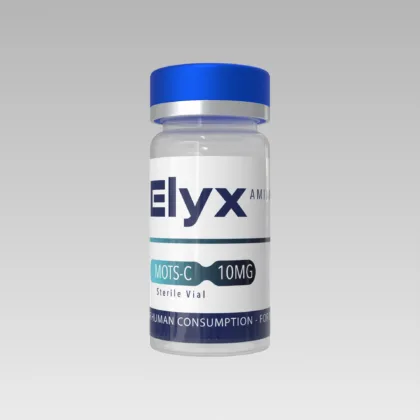
MOTS-C (Mitochondrial Open Reading frame of the Twelve S rRNA-c) is an endogenous 16-amino-acid peptide encoded within the human mitochondrial genome, specifically in the 12S ribosomal RNA subunit. Identified in 2015 by the Pinchas Cohen team at the University of Southern California, it represents a new class of mitochondria-derived peptides with systemic regulatory function.
Molecular structure:
- Secuencia: MRWQEMGYIFYPRKLR
- Peso molecular: aproximadamente 2,174 Da
- Biological origin: derived from human mitochondrial DNA
- Endogenous presence: detectable in human plasma, levels decreasing with age
The discovery of MOTS-C changed the classical understanding of the mitochondrion as a purely energetic organelle, revealing its role as a metabolic signaling node that communicates cellular state to the rest of the organism.
🔬 MOLECULAR MECHANISM OF ACTION
MOTS-C exerts its effects through multiple metabolic signaling pathways:
AMPK Activation:
The peptide directly activates AMPK (AMP-activated protein kinase), the cell's master energy sensor. AMPK activation triggers cascades that favor fatty acid oxidation, improve insulin-independent glucose uptake, and increase mitochondrial biogenesis.
Folate pathway regulation:
Modulates folate metabolism and the methionine cycle, impacting DNA methylation and epigenetic regulation associated with cellular aging.
Nuclear translocation under stress:
Under metabolic stress conditions (fasting, exercise, caloric restriction), MOTS-C translocates from the mitochondria to the nucleus, where it modulates the expression of adaptive genes as an integrated stress response.
Improvement of mitochondrial function:
Increases electron transport chain activity, improves coupling between oxidative phosphorylation and ATP production, and reduces mitochondrial reactive oxygen species (ROS) generation.
🧪 RESEARCH APPLICATIONS
Active research lines with MOTS-C documented in the scientific literature:
- Resistencia a la insulina: studies in murine models describe a 30 to 50% improvement in insulin sensitivity with chronic treatment
- Obesidad inducida por dieta: protection against weight gain in high-fat diet models
- Capacidad aeróbica y ejercicio: increased muscle oxidative capacity in preclinical models, a phenomenon described as “exercise in an injection” in the literature
- Envejecimiento metabólico: endogenous levels decline with age, which correlates with metabolic decline in the studies
- Fatty liver disease Reduced hepatic lipid content in NAFLD models
- Cardioprotección: effects on myocardial ischaemia-reperfusion in models
- Neuroprotection investigaciones preliminares sobre Parkinson y enfermedad de Alzheimer
🧪 LABORATORY PREPARATION (RECONSTITUTION)
Reference volumetric data for solution preparation in a laboratory setting:
The 40 mg vial can be reconstituted with 2 to 4 ml of bacteriostatic water. Resulting concentrations by diluent volume:
- With 2 ml: 20,000 mcg/ml concentration (200 mcg per unit on U-100 scale)
- With 4 ml: 10,000 mcg/ml concentration (100 mcg per unit on U-100 scale)
The U-100 scale is included solely as a laboratory volumetric reference for calculating aliquots from the prepared concentration. Store reconstituted material refrigerated and protect from light.
⚠️ HANDLING CONSIDERATIONS
MOTS-C is an endogenous peptide, and the preclinical literature and first published trials describe a notably clean tolerability profile. In the experimental context, the literature mainly documents:
- Reacciones locales leves y transitorias descritas en los estudios
- Cefalea ocasional reportada en fases tempranas
- Mild hypoglycaemia described in models with advanced insulin resistance
Given its mechanism of improving insulin sensitivity, the literature notes potential interactions with antidiabetic agents (sulfonylureas, insulin, metformin) as a variable to control for in experimental design. Always handle under appropriate laboratory practice.
🧬 COMBINED RESEARCH LINES
Combinations explored in the literature and in experimental designs:
- Resistencia metabólica + obesidad: MOTS-C + Tirzepatide, for the described synergy between the incretin and mitochondrial axes
- Longevidad celular: MOTS-C + NAD+ + Epithalon como triada estudiada en contextos de envejecimiento celular
- Capacidad oxidativa: MOTS-C + CJC No DAC + Ipamorelin en modelos de rendimiento aeróbico y composición corporal
- Fatty liver disease MOTS-C + GLP-3 Reta, estudiados para grasa visceral y hepática
- Función mitocondrial: MOTS-C + NAD+ for integrated mitochondrial support in research
📚 SCIENTIFIC REFERENCES
- Lee C, Zeng J, Drew BG, et al. The mitochondrial-derived peptide MOTS-c promotes metabolic homeostasis and reduces obesity and insulin resistance. Cell Metab. 2015;21(3):443-454.
- Reynolds JC, Lai RW, Woodhead JST, et al. MOTS-c is an exercise-induced mitochondrial-encoded regulator of age-dependent physical decline and muscle homeostasis. Nat Commun. 2021;12:470.
- Kim KH, Son JM, Benayoun BA, Lee C. The mitochondrial-encoded peptide MOTS-c translocates to the nucleus to regulate nuclear gene expression. Cell Metab. 2018;28(3):516-524.
- Yang Y, Gao H, Zhou H, et al. The role of mitochondrial-derived peptide MOTS-c in metabolic homeostasis. Pharmacol Res. 2019;143:166-171.
- Merry TL, Chan A, Woodhead JST, et al. Mitochondrial-derived peptides in energy metabolism. Am J Physiol Endocrinol Metab. 2020;319(4):E659-E666.
Product intended exclusively for scientific research purposes.
Research material only. This product is intended for scientific research in controlled laboratory settings only. It is not a drug. Not for human or animal use, not for diagnostic or therapeutic use.