
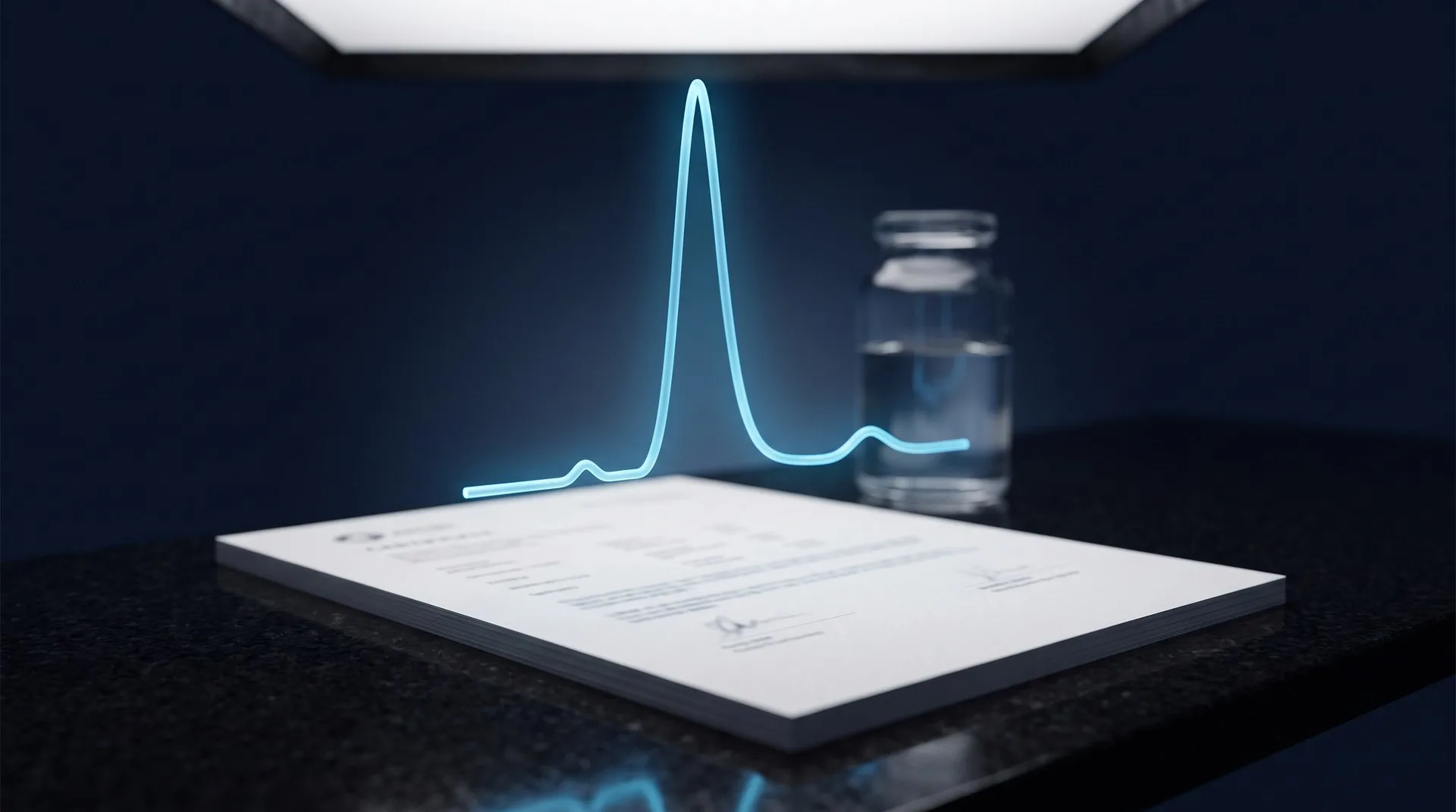
In a market where underdosing affects as much as 40–60% of the products available online, knowing how to read a Certificate of Analysis (COA) isn't a luxury—it's a necessity.
In this guide, we'll teach you how to interpret each section of a professional COA, identify counterfeits, and understand why independent verification is the gold standard.
What is a COA and Why Is It Important?
A Certificate of Analysis is a document issued by a laboratory that details the results of tests performed on a specific batch of product. It serves as the chemical “fingerprint” of the compound.
The Problem: Under-Dosing in the Market
Products labeled “5mg” that contain only 2-3mg of active peptide are alarmingly common. Other problems: bacterial contamination, endotoxins, heavy metals, and batch variation.
Anatomy of a Professional COA
1. Header and Identification
| Field | What to check | Example Elyx Aminos |
|---|---|---|
| Laboratory Name | Independently verifiable lab | Freedom Diagnostics Testing |
| Access Number | Unique identifier | 2512160145 |
| Client | Applicant Company | Elyx Aminos |
| Search Code | Verifiable on the lab's website | Elyx2512160145 |
| Product | Composition and presentation | GLP-3 RETA 5mg |
| Lot | Batch ID | EA-1001 |
| Dates | Reception and reporting | 12/16/25 – 12/18/2025 |
2. Net Peptide Content
A 5-mg vial may have a net content of 4.71 mg. This is normal: The weight includes salts (TFA), residual moisture, and counterions. The variation in 5-15% is scientifically expected.
3. Purity by HPLC
HPLC (High-Performance Liquid Chromatography) is the gold standard. How to interpret:
- A tall, well-defined main peak: Your target peptide. Higher and narrower = higher purity.
- Minimum secondary peaks: Impurities. In a premium product, they are virtually nonexistent.
- Clean baseline: Well-executed analysis without interference.
- Consistent retention time: Main peak in the expected time.
4. Mass Spectrometry
Confirm the molecular identity. Peaks such as [M+2H]²⁺ and [M+3H]³⁺ represent the same molecule with different charges. The values must match the theoretical molecular weight.
5. Safety Tests
| Test | What does it detect | Why It Matters |
|---|---|---|
| Infertility | Bacteria, fungi, yeasts | Injectable product safety |
| Endotoxins (LAL) | Bacterial lipopolysaccharides | They cause fever and inflammatory response |
| Heavy metals | Lead, mercury, arsenic, cadmium | Cumulative toxicity |
| Water Content | Residual moisture | It affects stability and power |
| Residual solvents | TFA, acetonitrile | Synthesis Contaminants |
Red Flags: Fake COA
| Warning Sign | What does it indicate |
|---|---|
| No lab name | Unable to verify source |
| Without HPLC chromatogram | It could be manufactured |
| Purity of 100.00% | Physically impossible |
| No lot number | Not associated with a specific product |
| No dates | Reusable for multiple batches |
| Cannot be verified online | No lab search code |
| Net content = exact weight | Unreal data |
How to Verify an Elyx Aminos COA
Step 1: Find the “Search Code” (format: Elyx + access number).
Step 2: Visit FreedomDiagnosticsTesting.com.
Step 3: Enter the search code.
Step 4: Compare results or scan the QR code provided.
Conclusion
The COA is your most powerful tool for protection. Learning how to read it allows you to make informed decisions.
At Elyx Aminos, we don't sell peptides. We sell verifiable trust. Every vial is backed by real data.
ELYX AMINOS
Premium Research Compounds · Verified Purity · Rigorous Science
www.elyxaminos.com · partnerships@elyxaminos.com · influencers@elyxaminos.com
Miami, Florida, USA.